The close of the 26th annual Conference of the Parties in mid-November spurred a flood of news headlines about the acceleration of the climate crisis. Globally, scientists agree that the last few years have been the hottest on record and that the oceans are rising at a rate previously unobserved. However, there remains a significant number of individuals who are indifferent to or skeptical of the severity (or even the existence) of the climate crisis. Others reject the anthropogenic aspect of this global phenomenon. As climate change worsens, staunch reluctance to the reality of the crisis and its origins becomes increasingly deleterious to collective efforts to stymie the worst of the impacts.
Changing minds about climate change is no easy task, but a 2020 study may have found hope in an unexpected resource: climate change fiction (also known as cli-fi). It turns out that narratives can reach skeptics in ways that blunt facts can’t. Schneider-Mayerson et al. (2020) found that stories of climate change impact readers through “transportation into the story and . . . identification with the characters.” Ironically, engaging with the climate crisis through a fictional medium makes climate change seem more real. The researchers focused on short stories in their study, but noted that “a novel might have larger and longer-lasting effects since its greater length and immersive detail could cause greater transportation and identification and provide more information about environmental issues.”
These encouraging findings are less impressive, however, if skeptical and indifferent readers aren’t actually picking up climate fiction novels in the first place. It's possible that the audience for climate fiction is composed of readers who are already convinced of the urgency of the climate crisis. Perhaps readers of cli-fi and looking for a medium in which to grapple with climate anxiety and don't need to be further convinced of humanity's role in rapidly warming the earth. But is the audience really so homogeneous?
One place to find the answer is Goodreads’ shelving data. As the internet’s most popular social network for readers, Goodreads concentrates the opinions and reading behaviors of millions of users through reviews, shelves, and ratings. While this resource may seem a boon for researchers studying reader interactions with texts, Walsh and Antoniak (2021) have discussed the shortcomings of the platform; Amazon’s influence over the site’s governing algorithms and digital infrastructure allows the corporation to determine which reviews are visible to users for a specific book, and the company also withholds the majority of the reviews from public view.
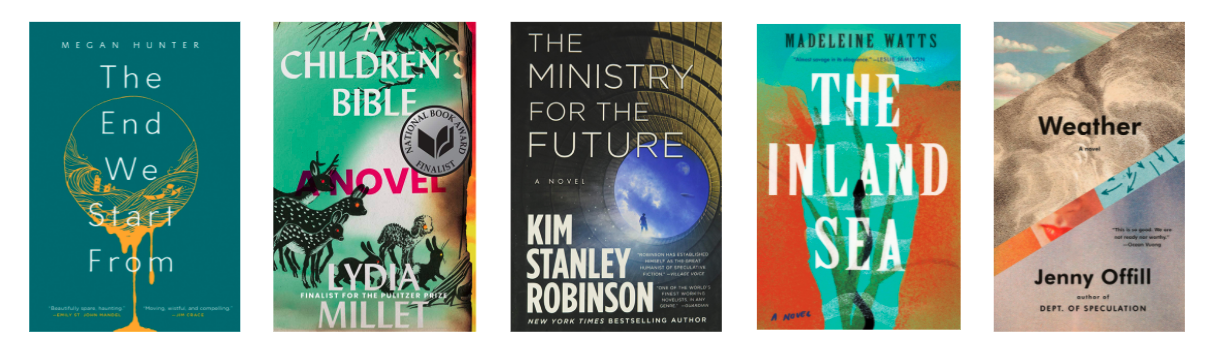
To gain a better understanding of which aspects of climate fiction attract readers, I turned to the top 100 shelves of five climate fiction novels. The Ministry for the Future by Kim Stanley Robinson, Weather by Jenny Offill, The Inland Sea by Madeleine Watts, The End We Start From by Megan Hunter, and A Children’s Bible by Lydia Millet served as the corpus for my study. These five works vary in several ways, notably in terms of their style, length, and author renown. All, however, were published within the last five years.
Literary genre was the broadest of the categories, encompassing all content-related shelves. There is some ambiguity as to what constitutes a genre; the Oxford English Dictionary defines it as “a particular style or category of works of art; esp. a type of literary work characterized by a particular form, style, or purpose.” For this study, “literary genre” refers to a category of literature distinguishable for its content and purpose. Practically, this includes genres like setting, adult fiction, dystopian fiction, and climate fiction. Though broad, this definition encompasses all major content areas in a novel that might be competing with the book's environmental subject matter.
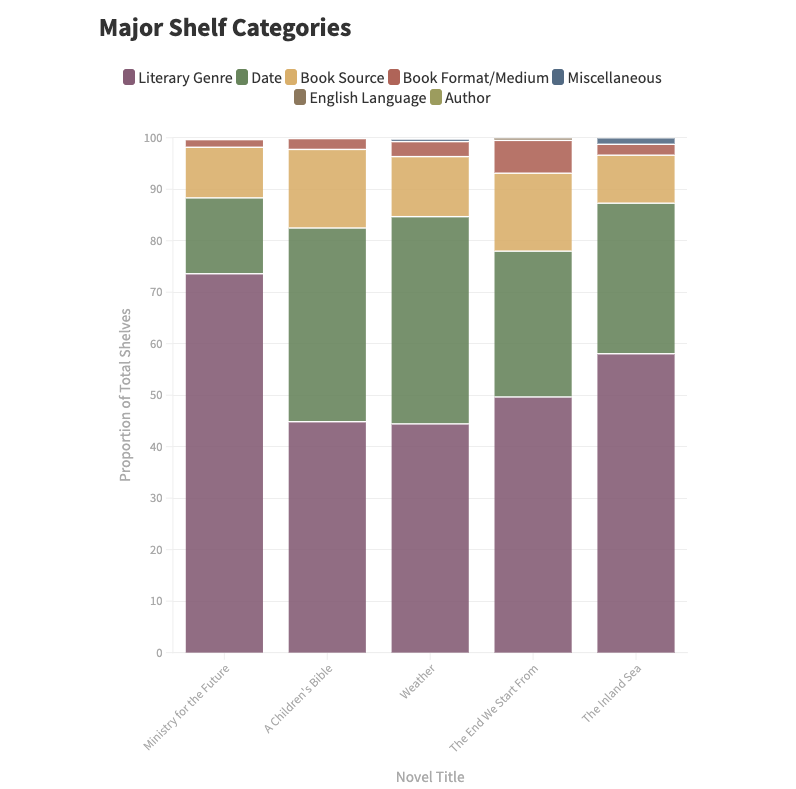
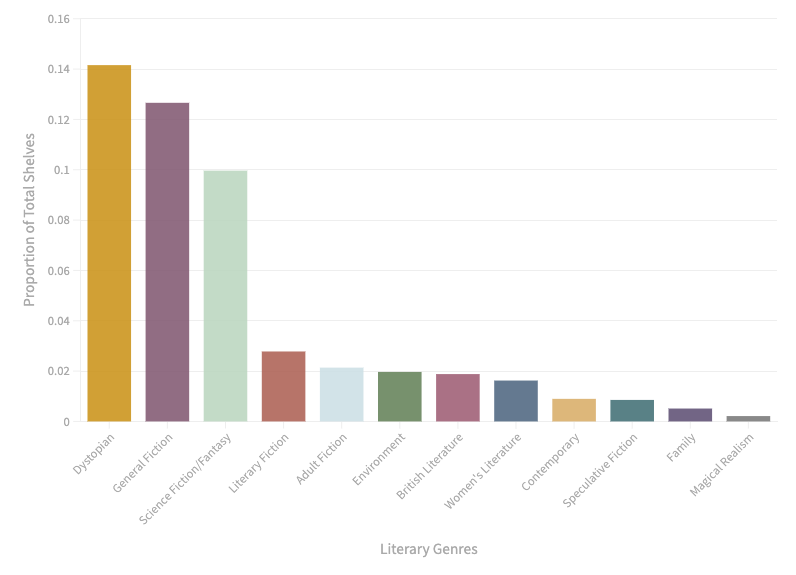
While readers shelve novels based on their publication date and/or medium some of the time, shelves relating to literary genre are the most popular in every case. Genre tags appear to be the most popular among cli-fi, indicating that readers (unsurprisingly) have an interest in the content of their novels. And if climate fiction was attracting readers who were seeking an environmentally-oriented read, we would assume that environmental shelf tags would dominate the literary genre category, reflecting the homogeneity of the cli-fi audience. The reality, however, is not so simple.
Breaking Down Literary Genre
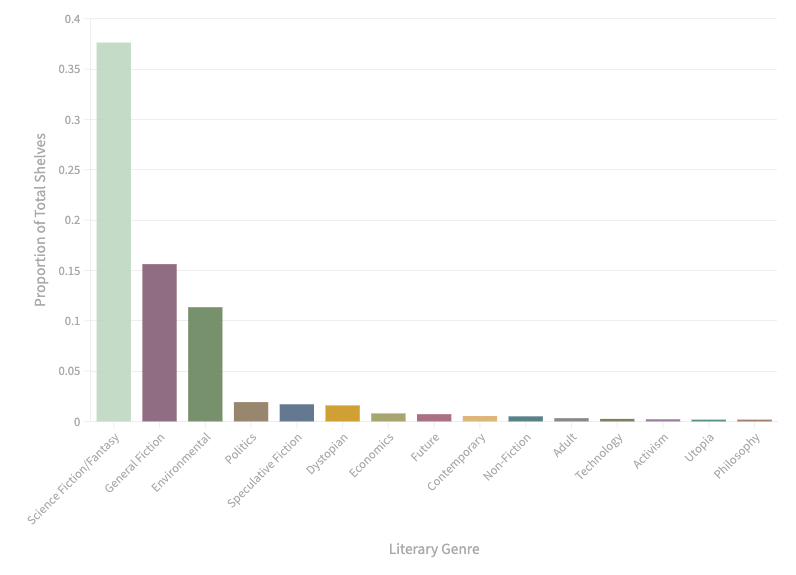
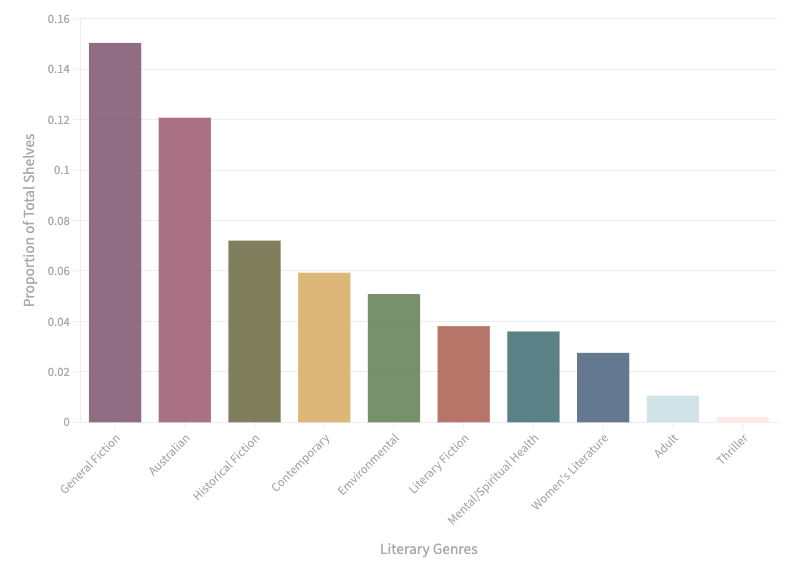
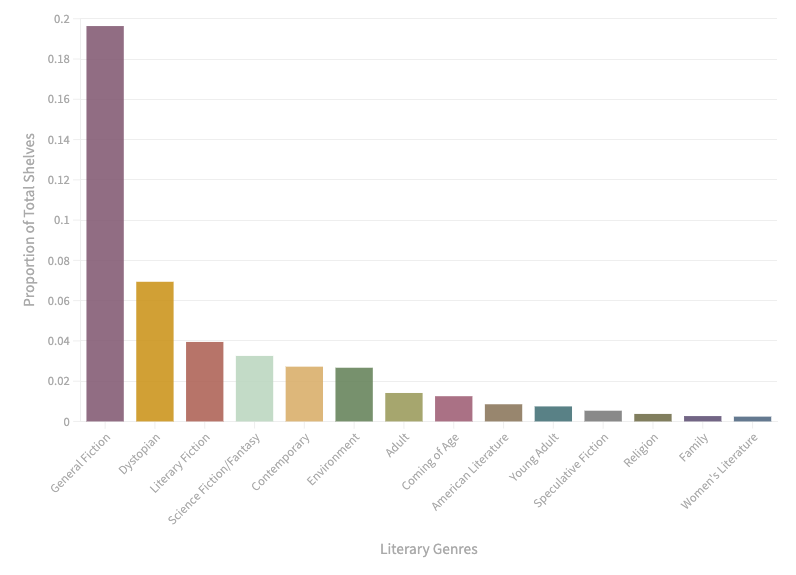
.jpeg)
While these findings are encouraging, these five novels are hardly representative of the thousands of novels in the climate fiction genre. To supplement my initial picture of the audience of climate fiction, I turned to five well-known climate fiction works: Flight Behavior by Barbara Kingsolver, The Water Knife by Paolo Bacigalupi, New York 2140 by Kim Stanley Robinson, Oryx and Crake by Margaret Atwood, and Parable of the Sower by Octavia Butler. I chose these novels from the Goodreads' climate fiction genre page where Goodreads offers a list of beginner climate fiction. I focused my study of this new corpus on the environmental shelves composition, and like the first five novels in my study, I found a lack of green in readers' shelving behaviors.
.png)
While there is bound to be some variation for a given novel's genre breakdowns, these 10 novels provide important insight into the broader shelving behaviors of climate fiction readers. Across all the novels in the study, the average percentage of environmental shelves was 4.1% of total shelves. This low statistic indicates that while readers are certainly aware of the climate content in cli-fi, the lion's share of their shelving attention is elsewhere.
Limitations and Future Directions
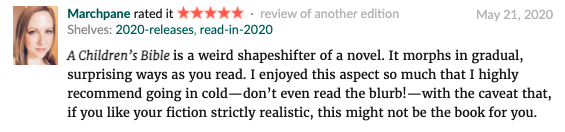
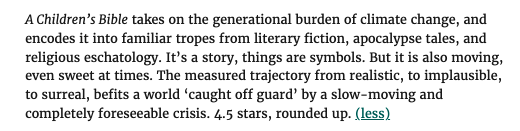
In an attempt to ameliorate the lack of context, I read the top ten user reviews for two novels: The Ministry for the Future and A Children's Bible. The former had the highest percentage of environmental shelves and the latter had one of the lowest.
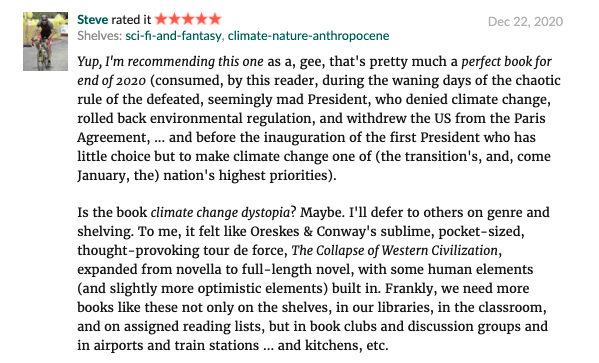
While working with this new corpus, I focused on reviews in which the user also listed the shelves to which they added the novel. And though this additional research does not by any means solve the problem of absent context, it does offer some additional insight. For The Ministry for the Future, the top reviews indicated that many users read the novel because they were already Kim Stanley Robinson fans. They also seemed to have strong preferences for cli-fi's parent genre, science fiction. But for one reviewer, genre was an ambiguous attribute of the novel. In his review, Goodreads user Steve stated that he intends to "defer to others on genre and shelving" and is uncertain if The Ministry for the Future qualifies as climate change dystopia. Despite this attitude, he nonetheless used the shelf tags "sci-fi-and-fantasy" and "climate-nature-anthropocene." Steve's thoughts indicate that even though he assigned shelf tags (one of which was environmentally related), he wasn't convinced that the novel fits into one genre.
While these findings leave plenty to be learned about reader curation of genre, they also provide important insight into the audience of climate fiction. The top shelves data show that readers primarily organize climate fiction based on literary genre, but often opt for genres unrelated to environmental content. Though we cannot know the exact composition of attitudes and beliefs of climate fiction readers, the top shelves of these ten novels indicate that the spectrum of audience interest is far from being solid green.